From local weighing to a reliable data chain
Weighbridges are essential in logistics, agriculture, construction, quarrying, and recycling. Yet many installations still rely on manual input, paper tickets, and isolated software.
Digitization is not simply about reading a weight. It connects the vehicle identity, transported material, driver, work order, and validation rules in one traceable process.
An end-to-end industrial architecture
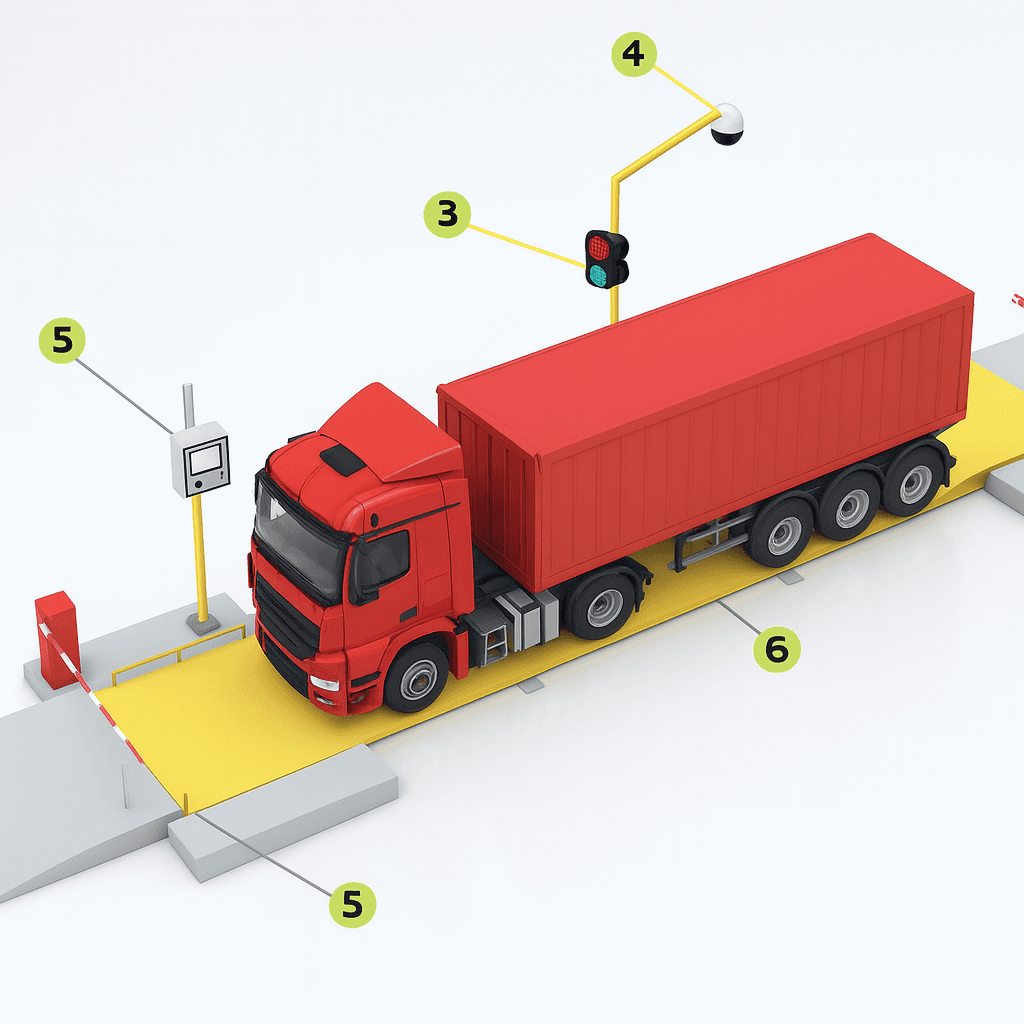
The AIO PLC connects to the weighing indicator via serial port, USB, or Ethernet. It collects and normalizes measurements in real time, then applies the required business rules before transmission.
An AIO HMI can guide the operator locally. The process can also integrate an ANPR camera for license-plate recognition, a barcode reader, traffic lights, and an automatic barrier.
- Reliable acquisition of stable weight and equipment status.
- Automatic, semi-automatic, or manual vehicle identification.
- Synchronization with a Cloud platform or an On-Premises server.
- API connectivity with ERP, MES, billing, and reporting tools.
Operational benefits
Every passage becomes a timestamped, verifiable record. Teams reduce duplicate data entry, process vehicles faster, and gain a consolidated view of inbound and outbound flows.
- Automation of repetitive operations and fewer errors.
- Complete traceability for audits and regulatory requirements.
- Real-time dashboards for volumes, waiting times, and anomalies.
- A scalable architecture that can accommodate additional cameras, sensors, or interfaces.
Use cases tailored to every industry
In agri-food operations, license-plate recognition speeds up the reception of grain trucks. In construction and mining, load control reduces overloads and discrepancies. In recycling, every movement becomes auditable. In transport, data feeds planning and billing directly.
With DigiSense, the weighbridge becomes a true digital gateway at the heart of logistics and industrial operations.
An approach tailored to the field
Every industrial context has its own constraints. Architecture, interfaces and deployment model are validated with the client before implementation.